
Insights
ENDURING Insights
Kiefer's Story: A Business Outgrowing Its Own Systems
Executive Summary:
Kiefer runs a growing company that has recently landed three large contracts with more in the pipeline — on the surface, everything looks like success. But underneath that momentum, the business is showing strain: leads are slipping through the cracks, reporting is falling behind, and the same information is being manually re-entered across multiple tools. The root cause isn't a lack of effort from his team — it's that the company has outgrown informal systems built on memory, inboxes, and spreadsheets. Growth, paradoxically, is creating drag.
After responding to a simple social media offer — "One problem. One demo. Zero pressure." — Kiefer joined a call that skipped the AI hype entirely and asked two straightforward questions: what actually happens when a new lead comes in, and how many places does the same information get entered? Those questions exposed the real issue: too many manual handoffs across too many disconnected systems. The takeaway isn't that Kiefer needs a massive software overhaul — it's that fixing one broken, repetitive process at a time can restore visibility, reduce wasted effort, and let his team focus on work that actually requires their judgment.
Automation Is Not Flashy AI: It’s the Boring Stuff That Makes Businesses Better
Artificial intelligence has become one of the most talked-about business topics of 2026. Depending on who you ask, AI is either the greatest productivity tool ever created or something to be feared. Some people are excited by it. Others are exhausted by it. Many business owners are somewhere in the middle, wondering whether they actually need AI at all.
Business automation is not a robot taking over the office. It’s not artificial intelligence making unpredictable choices without oversight. It is a controlled system of step-by-step instructions, functions, formulas, scripts, and workflows that help repeatable processes happen the same way every time. It moves information where it needs to go, reminds people what needs attention, creates visibility for managers, and gives teams more time to focus on the work that actually requires human judgment.
In other words, automation handles the boring stuff that quietly slows a business down.
That is where Kiefer’s story begins.
Growth Is Good — Until the Process Starts Leaking
Kiefer’s company is on a roll. Three large contracts were signed this month heading into summer, and two more promising bids are sitting in the pipeline. The sales team is energized, the calendar is filling up, and revenue is moving in the right direction.
From the outside, everything looks like momentum. Inside the business, though, the workflow is starting to show cracks.
Emails are getting buried inside long conversation threads. New leads are still coming in through website forms, referrals, and customer calls, but the company’s focus on the new jobs is causing some of those leads to slip away unnoticed. Weekly reporting has become too manual, so it keeps getting pushed behind more urgent administrative work. Marketing has slowed down because the same people who normally keep it moving are now pulled into job coordination, customer communication, and piles of paperwork.
And now, because sales are strong, Kiefer needs to think about hiring more people just to keep up. That sounds like a good problem to have, and in many ways it is. But good problems can still become expensive problems when a company has outgrown the systems that used to support it.
The issue is not that Kiefer’s team is lazy. It’s not that they don’t care. The issue is that too much of the company’s process still depends on memory, inboxes, spreadsheets, and manual handoffs.
When a business is smaller, those habits can work for a while. People remember who needs to be called back. Someone updates the spreadsheet. A manager asks for a quick status update in the hallway. But as revenue grows, those informal systems become less reliable. The same workflow that worked at one size starts leaking as growth takes hold.
Those leaks are not always dramatic. They often show up as a lead that doesn’t get called back until two days later, a proposal that sits half-finished because the details are scattered, a customer email that gets buried under a newer thread, or the same information being typed into multiple systems.
None of these issues feel catastrophic on their own. Together, they create drag. They slow down follow-up, frustrate employees, create blind spots for managers, and make growth feel heavier than it should.
One Problem, One Demo, Zero Pressure
Late one evening, Kiefer came across a simple offer while scrolling through social media:
One problem. One demo. Zero pressure.
The post was not promising to replace his staff with AI. It was not filled with technical jargon. It simply asked whether one broken process was costing the business time, visibility, or revenue.
Kiefer paused. “What’s to lose?” he thought, and filled out the questionnaire.
The form asked him to identify one business process that felt more manual, scattered, or frustrating than it should. Kiefer smiled at the idea of having only one problem to choose from, so he made a quick list:
Lead tracking and follow-up falling through the cracks
Estimating and proposal chaos
Job costing and budget visibility
Document and photo management
Repetitive data entry across software tools
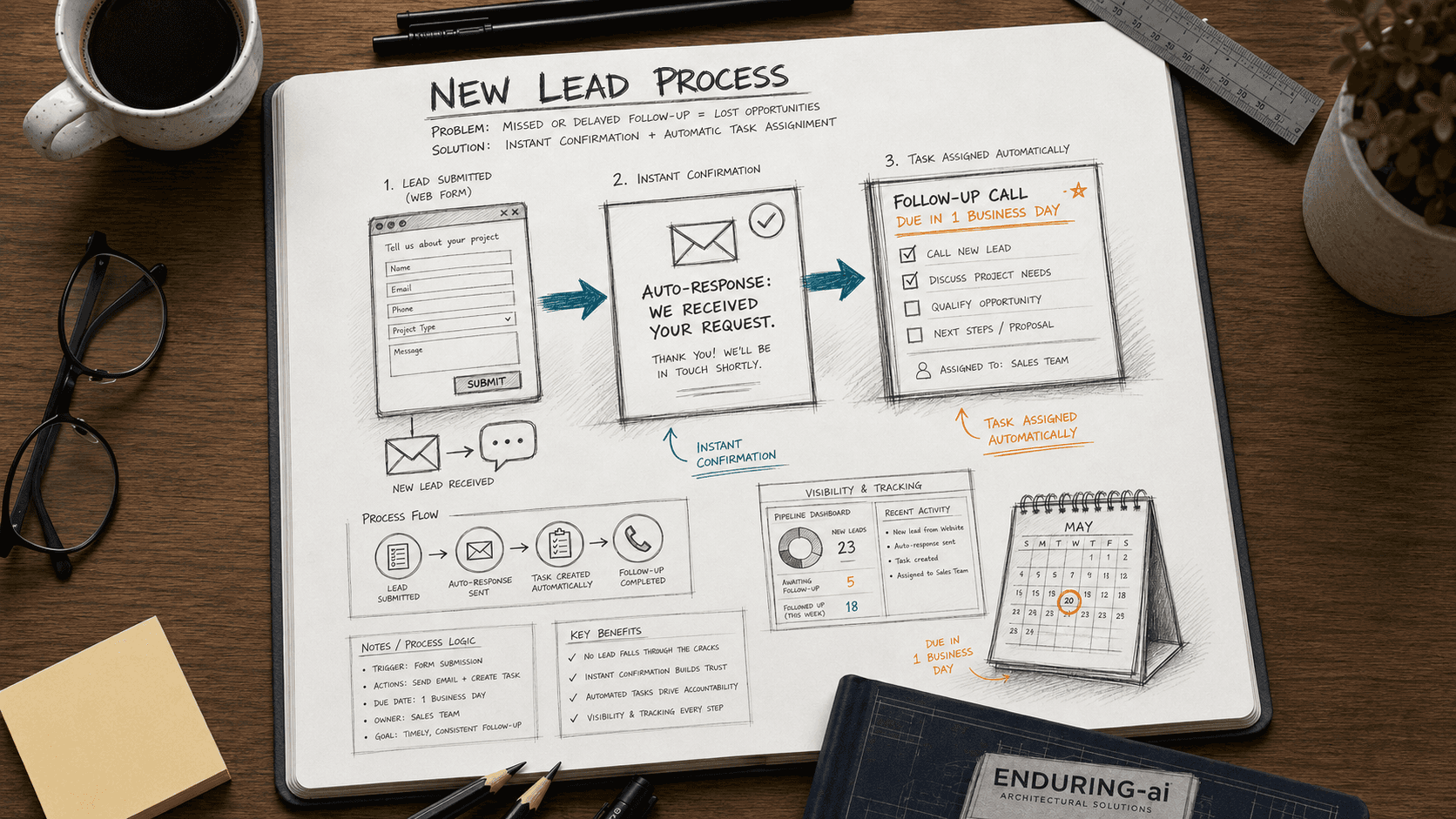
For the demo, he decided to focus on lead tracking and repetitive data entry. That seemed like enough to give the automation company something useful to work with. He hit send. Four minutes later, an email arrived with a link to schedule the call.
The irony was not lost on him. He had just submitted a form about slow follow-up and received a clear, professional response before he had even closed his laptop. Impressed, he scheduled the call for 8:30 the next morning and turned out the light.
The Demo Was Not Flashy. That Was the Point.
The next morning, Kiefer joined the call expecting some kind of futuristic AI sales pitch. Instead, the conversation started with a simple question:
“What happens today when a new lead comes in?”
Kiefer walked through the process. A form submission hits the inbox. Someone reads it. If it looks urgent, they forward it to the right person. Sometimes it gets added to a spreadsheet. Sometimes someone creates a reminder. If the customer calls back, someone searches the inbox for the original request. If the lead turns into an estimate, the details are typed again somewhere else.
The process was not broken because people were careless. It was broken because too much depended on people remembering every handoff.
Then came the second question:
“How many places does the same information get entered?”
Kiefer thought about it. Website form. Email. Spreadsheet. Estimating tool. Calendar. Customer folder. Maybe the CRM if someone had time.
Too many. That was the real problem. Not AI. Not software. Not even people. The company had too many manual handoffs and too many disconnected places where important information could get lost.
The Boring Stuff Is Where the Money Is
It is tempting to believe that business improvement has to be dramatic. A new platform. A major software rollout. A large AI initiative. A complete operational overhaul.
But for many small businesses, the biggest improvements come from fixing the boring stuff: capturing leads consistently, sending follow-up reminders, updating records automatically, reducing duplicate data entry, routing information to the right person, making overdue work visible, and building simple dashboards that answer basic business questions.
None of that sounds flashy, but it matters because the boring stuff is often where time disappears. It is where leads get missed, employees get frustrated, owners lose visibility, and growth starts feeling chaotic instead of exciting.
Automation Does Not Replace People. It Protects Their Time.
One of the biggest fears around automation is that it will replace people. For most small businesses, a better question is this:
How much of your team’s day is being spent on work that does not require their judgment, experience, or customer knowledge?
Kiefer did not want to replace his team. He wanted his team to stop drowning in repetitive tasks. He wanted customer information to move automatically, follow-ups to be visible, and reporting to take less manual effort. He wanted his people focused on relationships, customer service, problem-solving, quality control, and growth.
Automation did not remove people from the process. It removed friction from the process.
That distinction matters.
People are still needed for decisions, conversations, leadership, empathy, negotiation, and trust. Automation simply helps prevent good employees from spending too much of their day acting like copy-and-paste machines.
Start Small. Fix What Leaks First.
For many small businesses, automation feels intimidating because they imagine it has to be big. In reality, the best place to start is usually small.
Pick one process that is repetitive, visible, and painful. New lead intake is a great example. So are follow-up reminders, estimate tracking, customer onboarding, weekly reporting, task assignment, document collection, and missed renewal reminders.
The goal is not to automate the entire business overnight. The goal is to prove that one better workflow can save time, reduce mistakes, and improve visibility. Once one process works, the next one becomes even easier.
That’s how practical automation grows: one useful improvement at a time.
Better Systems Beat Bigger Hype
AI will continue to get headlines. Some of those headlines will be exciting. Some will be alarming. Some will be exaggerated. But while everyone else is arguing about the future of artificial intelligence, small businesses still have today’s operational problems to solve. Leads need follow-up. Customers need answers. Reports need visibility. Tasks need ownership. Information needs to move.
That’s why business automation matters. Not because it’s trendy, but because it is useful. Not because it replaces people, but because it gives them time back. Not because it promises magic, but because it fixes the boring stuff that quietly makes businesses better.
At ENDURING-ai, we build practical automation systems for small businesses using tools like Make, Airtable, and Google Workspace. The value does not come from hype. It comes from identifying one broken process, rebuilding it with better structure, and helping your team spend less time chasing information and more time growing the business.
So before you ask, “Do we need AI?” ask a better question:
What repetitive process is costing us time, visibility, or revenue right now?
If you would like to see what that looks like in your own business, schedule a quick call at schedule.enduring-ai.com.
One problem. One demo. Zero pressure.
Changelog