
Insights
Enduring Insights
Core idea: The goal of automation is not to remove the human from the work. It is to remove the unnecessary work from the human.
Emily Isn’t Lazy. She’s Buried.
It is 9:00 AM on a sunny Monday morning. Coffee is brewing, keyboards are clicking, and the office is coming alive.
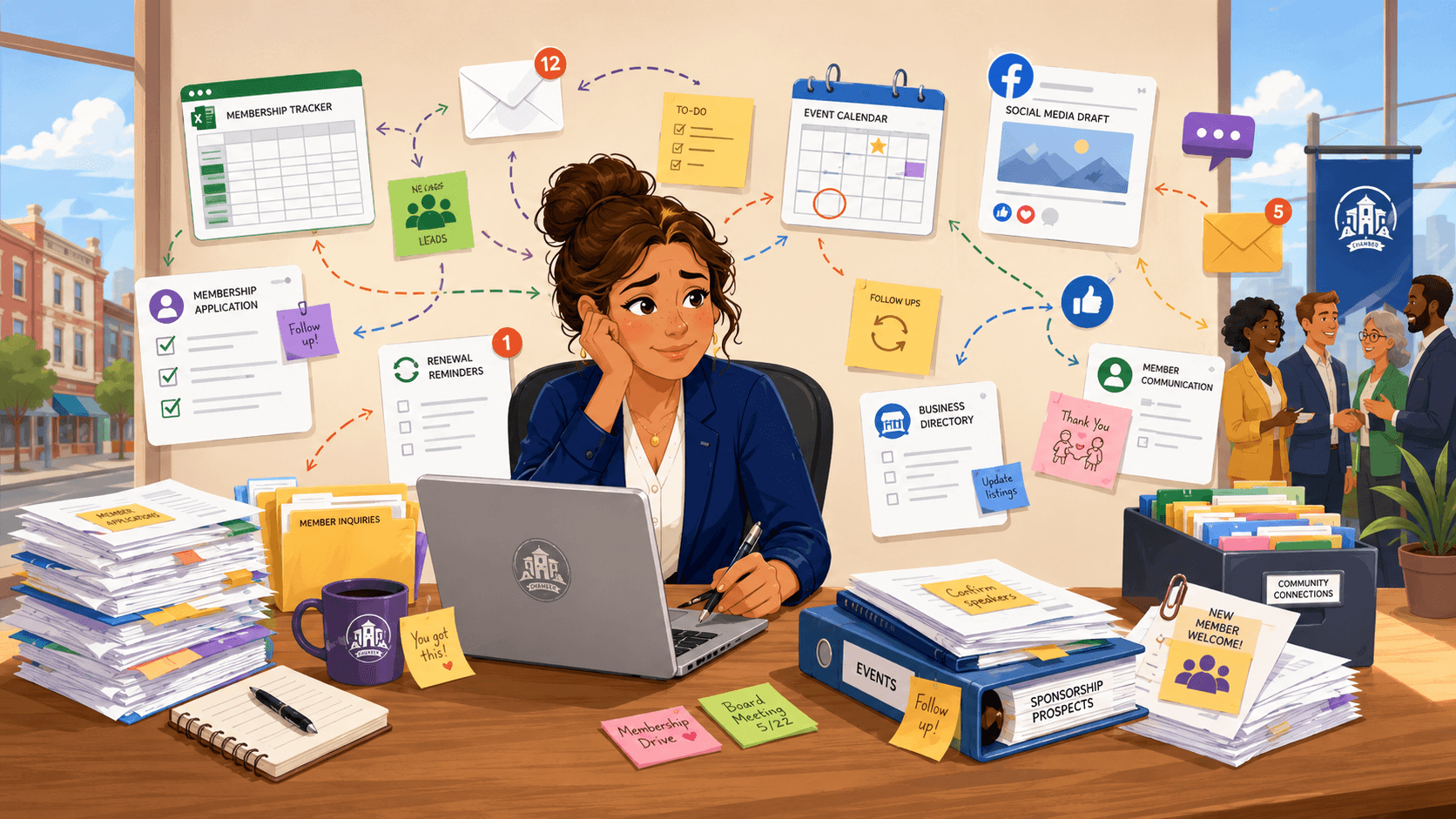
But over Emily’s desk, there is a gray cloud: piles of paperwork, twenty-two browser tabs, a half-filled planner, and a growing list of follow-ups, data entry, and social posts - all due by 5:00.
Emily is not lazy. She is buried.
She wants to engage with clients, solve problems, and contribute to growth. Instead, much of her day is spent moving information from one place to another. It looks like productivity from the outside. From Emily’s side of the desk, it feels like quicksand.
The Real Cost of Manual Work
This scenario repeats itself in offices everywhere. The problem is not that people are unwilling to work. The problem is that too much of the work is repetitive, manual, and disconnected from the value the business actually wants to create.
The hidden cost shows up quietly: typos from rushing to the next task, lost leads from an “I’ll get to that after this report” mindset, forgotten follow-ups, slower response times, and calendars that become storage units for unfinished work.
Every minute spent copying data into a spreadsheet, rebuilding a social post, chasing a form, or manually updating a customer record is a minute not spent closing a deal, solving a client problem, or improving the customer experience.
That is opportunity cost: the value a business gives up when time, attention, and energy are spent on lower-value work instead of higher-value work. Emily knows it. Her manager knows it. Most importantly, clients feel it when responses slip from minutes to hours, then hopefully to the next day.
The Scaling Wall
Many growing businesses eventually hit what I call the Scaling Wall: the point where revenue, customer demand, and expectations keep increasing, but the systems behind the business cannot keep up.
The warning sign is simple. Every new sale creates almost the same amount of new administrative work. The sales team celebrates the win, while Emily quietly dreads the additional forms, follow-ups, updates, and reminders that come with it.
That is not scalable growth. That is growth wearing a backpack full of bricks.
A business should not expect revenue to grow while administrative work continues growing at the same 1:1 ratio. At some point, the team either burns out, misses details, or starts browsing job boards after dinner.
What Automation Actually Changes
Workflow automation is not about replacing people like Emily. It is about giving them the time and autonomy to do the work only humans can do: build relationships, make judgment calls, solve messy customer problems, negotiate, listen, empathize, and spot opportunities.
Let’s say there is a 20-step process from the moment a lead submits a form to the moment a face-to-face meeting is scheduled. Emily may have to complete that process several times a day. What happens if a well-designed automated workflow removes 14 of those steps?
That is a 70% reduction in busy work. Not a 70% reduction in people. A 70% reduction in repetitive work that never needed to be done by hand in the first place. |
Now Emily has more time to follow up with prospects, serve existing customers, prepare better for meetings, and help move the business forward. Her stress goes down. Her usefulness goes up. The business benefits from both.
The Math Gets Real Quickly
Imagine Emily spends two hours a day processing handwritten forms and entering information into a CRM. That is 10 hours per week, 40 hours per month, and roughly 480 hours per year.
If two other people in the department are doing the same thing, the business is now spending about 1,440 hours per year on form processing and data entry. At roughly $20 per hour, that is nearly $30,000 in labor spent mostly moving information from one place to another. |
The question is not whether Emily is working hard. She is. The better question is whether the business is spending her talent on the right work.
Enter the Digital Assistant
This is where tools like Make, Airtable, and Google Workspace can create meaningful value. Together, they can support repeatable workflows that capture information, organize it, trigger follow-ups, send notifications, update records, and create visibility for the team.
At ENDURING-ai, custom-built automation systems are designed to act like a digital assistant for the business. Not Emily’s replacement. Not a headcount reduction strategy. Not a magic wand. A practical system that handles repetitive work consistently so people can focus on higher-value work.
Most small-business automation is not science fiction. It is not a robot sitting at Emily’s desk. It is process design, formulas, scripts, integrations, clear dashboards, and carefully selected AI where it actually adds value. In many practical systems, AI may only be a small part of the solution. The process is the engine.
Dashboards Reduce the Guesswork
Automation does more than move data. It can also improve visibility.
Instead of waiting for update meetings to discover what fell behind, managers can start the day with dashboards that show open tasks, overdue follow-ups, unassigned work, lead status, response times, and department activity.
That does not eliminate the need for human conversations. It makes those conversations better. Meetings become less about hunting for information and more about making decisions.
The Road Less Traveled
Many small businesses still say they are too small for automation, do not need more systems, or cannot afford the investment. In reality, practical automation can help address all three concerns.
It helps a small team act more organized before growth gets messy. It reduces complexity by creating clearer processes, not more chaos. And when repetitive work is reduced, the business can redirect time, attention, and money toward customer service, follow-up, and growth.
So which path makes more sense in 2026: hiring more people to manage a broken process, or building a system that helps the current team scale with less friction?
A Better Monday Morning
If your team did not have to touch a single repetitive administrative task on Monday morning, what is the first high-value thing they could do instead?
That is the question worth asking.
At ENDURING-ai, we help small businesses build practical automation systems that reduce repetitive work, improve visibility, and prepare the business for growth - without turning the workplace into a science project.
Because automation is not replacing Emily. It is giving her Monday morning back.
Changelog